A pork stew, accompanied with potato rosti patties.
The patties were made with potato rosti, one egg, two tablespoonfuls of cornmeal (cornflour will do just as well), and several pinches of the herb sage. I used an ice-cream scoop to shape the patties. Cooked under glass in a little olive oil, until they were ready (about twelve minutes).
The pork stew was made with chopped selections from a roasted joint of pork. Cooked with tinned tomato, mushrooms, leek,vegetable and pork stock, and numerous herbs (oregano, tarragon).
Delicious food, mostly cooked from scratch. Often wheat-free. Search the recipes using the ingredient tags. Click to enlarge images. 1160+ recipe ideas and counting!
Showing posts with label Cornmeal. Show all posts
Friday, 15 May 2020
Potato Rosti Patties, with Pork Stew
Thursday, 12 March 2020
Beef and Chestnut Mushroom Stew
Some leftover cooked silverside beef was the basis for this dish. Stir-fried for five minutes in olive oil, along with some julienned red onion, and then I added a mixture of cornmeal, onion granules and water. Stirred together thoroughly. Simmered for half an hour.
Three quartered chestnut mushrooms were added. Cooked under glass for another half an hour, along with the addition of beef stock (an Oxo cube will do).
Served with black pepper and basmati rice, cooked for around twelve minutes. A tasty dish!
Three quartered chestnut mushrooms were added. Cooked under glass for another half an hour, along with the addition of beef stock (an Oxo cube will do).
Served with black pepper and basmati rice, cooked for around twelve minutes. A tasty dish!
Tuesday, 11 February 2020
Mince, Potatoes and Green Beans
A delicious variation on this favourite British dish.
Diced leek and carrot were stir-fried slowly for twenty minutes in some sunflower oil. The vegetables were decanted to another pot and boiling water was added to it. Slowly simmered for half an hour.
The ground beef was added to the original saute pan, and browned over twenty minutes (judge progress by eye).
Then the ground beef was decanted to the pot containing the vegetables using a slatted spoon, leaving the surplus beef fat in the saute pan. Stir through thoroughly, and add the vegetable stock, two dashes of dark soy sauce, half a teaspoonful of paprika, and half a dessert spoonful of cornmeal. Stir together. Allow to simmer under glass for forty-five minutes or so, by which time the beef will be beautifully tender.
Serve with boiled potatoes cooked for twenty minutes, and green beans boiled for seven minutes.
Diced leek and carrot were stir-fried slowly for twenty minutes in some sunflower oil. The vegetables were decanted to another pot and boiling water was added to it. Slowly simmered for half an hour.
The ground beef was added to the original saute pan, and browned over twenty minutes (judge progress by eye).
Then the ground beef was decanted to the pot containing the vegetables using a slatted spoon, leaving the surplus beef fat in the saute pan. Stir through thoroughly, and add the vegetable stock, two dashes of dark soy sauce, half a teaspoonful of paprika, and half a dessert spoonful of cornmeal. Stir together. Allow to simmer under glass for forty-five minutes or so, by which time the beef will be beautifully tender.
Serve with boiled potatoes cooked for twenty minutes, and green beans boiled for seven minutes.
Sunday, 19 January 2020
Beef Chilli with Potato and Mange Tout
Beef and Potato Chilli, served with diced mange tout.Ground beef mince, browned in sunflower oil, for around twenty five minutes. After that, diced carrot and onion were added to the beef, along with a single chopped garlic clove, and some deseeded red chilli.
Cooked for a further twenty minutes under glass, after which about 200 mls of boiling water, along with the beef stock. In addition, I added about half a dessert spoonful of cornmeal, mixed with cold water, and stirred the mixture into the beef.
The potatoes were cooked in a separate small pot for twenty minutes in salted water. After thirteen minutes the diced mange tout was added to the pot, and simmered under glass for another seven minutes. Drain, and serve with the beef chilli.
Saturday, 28 December 2019
Beef Bourguignon
One of the most famous French dishes, though it is lacking documentation before the nineteenth century. Essentially it is a beef stew, cooked with diced onions, mushrooms and garlic, and simmered for a couple of hours in beef stock and some red wine. Often cooked with a little chopped bacon, but this addition is an uneccessary detail. I added a little diced carrot to lend some sweetness.
The onions were fried in some olive oil until they began to brown, then the diced beef was added and browned for twenty minutes, stirring frequently. Add the quartered mushrooms and the diced garlic. Cook for another ten minutes. Add the beef stock and half a glass of red wine. Mix some cornmeal with water, and add to the pot, stirring for five minutes. Add the herbs.
Simmer under glass for between one and two hours, according to preference. Served in this case with brocolli spears, boiled in salted water for seven minutes under glass. More usually served with boiled potatoes or rice.
The onions were fried in some olive oil until they began to brown, then the diced beef was added and browned for twenty minutes, stirring frequently. Add the quartered mushrooms and the diced garlic. Cook for another ten minutes. Add the beef stock and half a glass of red wine. Mix some cornmeal with water, and add to the pot, stirring for five minutes. Add the herbs.
Simmer under glass for between one and two hours, according to preference. Served in this case with brocolli spears, boiled in salted water for seven minutes under glass. More usually served with boiled potatoes or rice.
Labels:
Beef,
Beef bourguignon,
Beef Stock,
Brocolli,
Brocolli Spears,
Burgundy,
Carrot,
Coriander,
Cornmeal,
Garlic,
Herbes de Provence,
Herbs,
Mushrooms,
Olive Oil,
Onion,
Red Wine,
Salt,
Wine
Friday, 18 October 2019
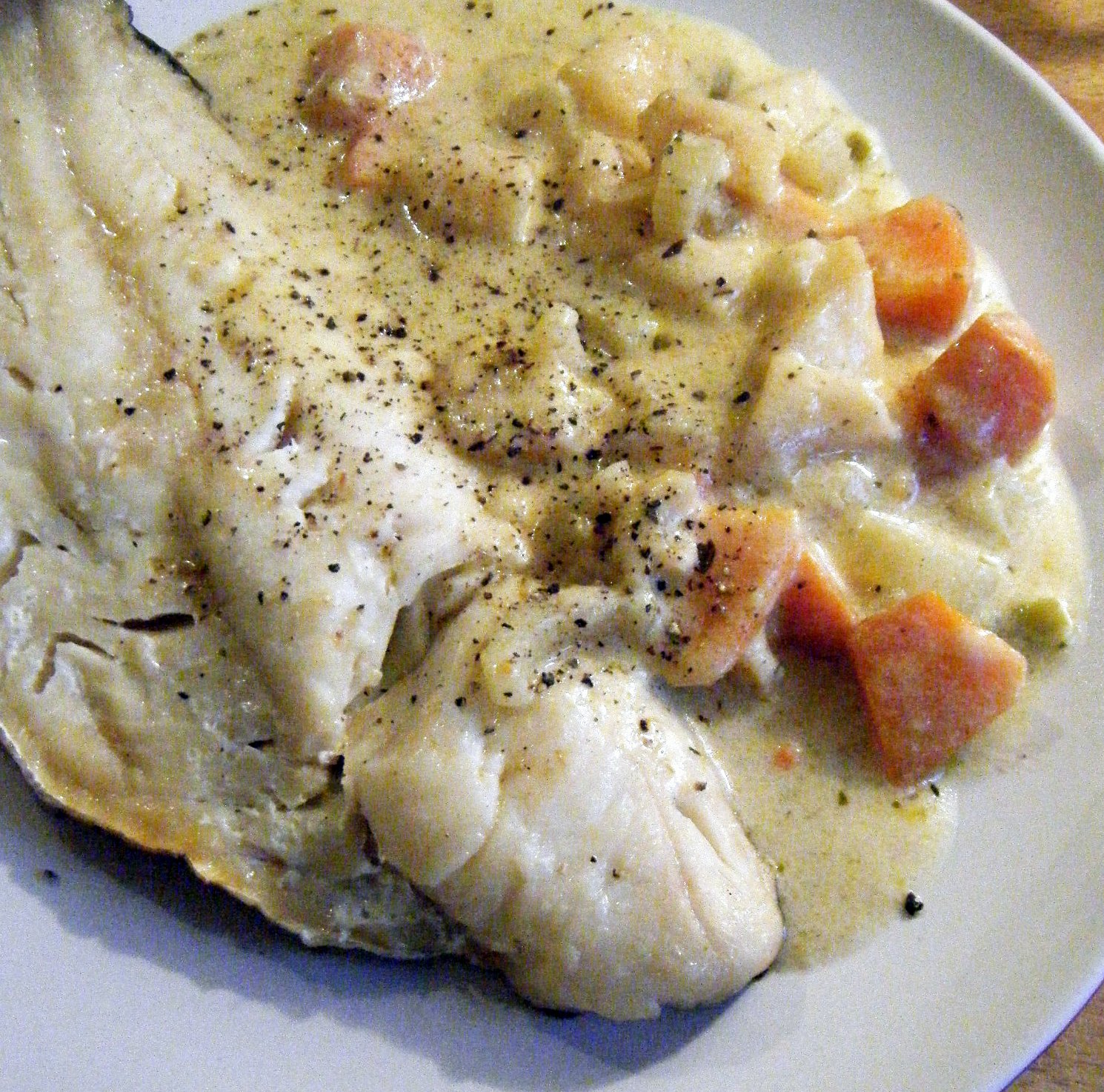
Smoked Haddock with Vegetables in a Cheese Sauce
A large fillet of haddock, smoked but undyed, poached in water in a flat lidded pan for twenty minutes. Starting at a high heat, and then reduced to the lowest heat when the water began to boil.
In another pan, the diced vegetables (parsnip, potato, carrot, spring onion) were boiled for twenty-five minutes.
While the vegetables were cooking, I prepared the cheese sauce.
I mixed whole milk (around 150 mls) and a dessert spoonful of cornmeal flour in a jug, plus some vegetable stock, and decanted the mixture (with a little butter) into a third pot, and stirred it until it began to thicken on the hob. I added the vegetables, and around 100g of cheddar cheese (thin slices), and stirred until the cheese had entirely melted.
Dress with freshly ground black pepper, and serve!
In another pan, the diced vegetables (parsnip, potato, carrot, spring onion) were boiled for twenty-five minutes.
While the vegetables were cooking, I prepared the cheese sauce.
I mixed whole milk (around 150 mls) and a dessert spoonful of cornmeal flour in a jug, plus some vegetable stock, and decanted the mixture (with a little butter) into a third pot, and stirred it until it began to thicken on the hob. I added the vegetables, and around 100g of cheddar cheese (thin slices), and stirred until the cheese had entirely melted.
Dress with freshly ground black pepper, and serve!
Monday, 30 September 2019
Cauliflower Cheese Tray Bake
Cauliflower florets in a cheddar cheese sauce made with cornmeal.The cornmeal, milk and cheese sauce was made first.
The chopped baby plum tomatoes, carrot, garden peas (from the pod), diced mushrooms were added to the cauliflower florets in a non-stick oven proof dish. The bubbling cheese sauce (100g of cheese) was poured over the top of the vegetables.
A further 150g of cheddar was grated over the top of the dish, spread as evenly as possible.
The oven was preheated to 190 deg C (about 25 minutes to wait) and the dish was placed on the middle shelf. Cook for at least 45 minutes, and judge by eye when it is ready.
Serve dressed with freshly ground black pepper. Delicious!
Monday, 9 September 2019
Cream of Chicken Soup
A delicious and easy to prepare cream of chicken soup.
The chicken came from roasted chicken thighs, deskinned. I removed the meat from the bones with my fingers.
I stir-fried some white onion and chopped mange tout in a little butter. Once soft, the onions were removed from the heat.
I mixed cornmeal (a dessert spoonful), water and milk in a bowl (250 mls), and added the mixture to the pan with the onions and mange tout. Bring to the boil, stirring thoroughly.
Add the chicken meat. Cook for half an hour at a medium heat, stirring every few minutes.
Add the Herbes de Provence and the chicken stock ten minutes before serving.
The chicken came from roasted chicken thighs, deskinned. I removed the meat from the bones with my fingers.
I stir-fried some white onion and chopped mange tout in a little butter. Once soft, the onions were removed from the heat.
I mixed cornmeal (a dessert spoonful), water and milk in a bowl (250 mls), and added the mixture to the pan with the onions and mange tout. Bring to the boil, stirring thoroughly.
Add the chicken meat. Cook for half an hour at a medium heat, stirring every few minutes.
Add the Herbes de Provence and the chicken stock ten minutes before serving.
Wednesday, 31 July 2019
Baked Pasta Cheese with Chorizo Sausage
A variation on macaroni cheese, made with wheat-free pasta, chorizo sausage, spring onion and tomato, with Cheddar cheese.
I diced about 50g of chorizo, and fried it slowly in an omelette pan for about twenty minutes. The diced tomato was added, along with the spring onion. Cook in the fat from the chorizo for another fifteen minutes.
The stir-fry was decanted into a pyrex bowl. Once the pasta was prepared, it too was added, and stirred through.
Next I made the pasta sauce with cornmeal (use cornflour if you prefer a finer texture), milk and about 50g of grated cheddar. Heated in a saucepan (stirring almost constantly) until the cheese had melted, and the sauce had begun to thicken.
After that the saucepan was removed from the heat, and the sauce was decanted into the pyrex bowl, and stirred in thoroughly. Add white pepper.
Grate another 50g of cheddar and sprinkle on top. Preheat the oven to 190 deg C (about twenty minutes or so), and place on the middle shelf. It should be ready in 40 to 45 minutes, by which time the cheese topping should have begun to brown. Delicious!
Labels:
Baby Plum Tomato,
Cheddar,
Cheese,
Chorizo,
Cornmeal,
Fusili,
Milk,
Pasta,
Pasta Cheese,
Pepper,
Salt,
Sausage,
Spring Onion,
Tomato
Tuesday, 26 February 2019
Pork and Leek Meatloaf
Bargain sausagemeat from Sainsbury's, so I made a meatloaf with it, using oats, cornmeal, diced leek and herbs (rosemary in this case, but sage is also a good choice).
The ingredients were mixed initially by hand in a large pyrex bowl, until the vegetables and meat were thoroughly mixed together. I also added a little sunflower oil, and one large egg.
The mixing can take up to ten minutes. I added a little salt and the rosemary during this process.
After that I continued the mixing process using a medium sized wooden spoon for another seven minutes or so.
Then the mix was decanted into a silicon bread tin, patted down and textured with a fork. Cooked for one hour at 190 deg C on the middle shelf of the oven (check progress occasionally). The meatloaf will shrink a little during the cooking process, so there is no problem getting the loaf out of the tin in one piece after it has cooled.
Served in this case with Brussels sprouts and some cranberry jelly, and some sliced yellow pepper. Dusted with a little parsley.
The ingredients were mixed initially by hand in a large pyrex bowl, until the vegetables and meat were thoroughly mixed together. I also added a little sunflower oil, and one large egg.
The mixing can take up to ten minutes. I added a little salt and the rosemary during this process.
After that I continued the mixing process using a medium sized wooden spoon for another seven minutes or so.
Then the mix was decanted into a silicon bread tin, patted down and textured with a fork. Cooked for one hour at 190 deg C on the middle shelf of the oven (check progress occasionally). The meatloaf will shrink a little during the cooking process, so there is no problem getting the loaf out of the tin in one piece after it has cooled.
Served in this case with Brussels sprouts and some cranberry jelly, and some sliced yellow pepper. Dusted with a little parsley.
Friday, 8 February 2019
Haggis and Chips, with Fried Turnip
This delicious dish is slightly heretical. Normally haggis is served with boiled potatoes (sometimes mashed), and mashed turnip. However the main component of the dish has a history much older than the advent of potatoes in Europe, so the dish has already undergone changes.
Traditional Scottish cooking is based on three basic processes, which were standard all the way back into the neolithic, and beyond: griddle cooking (oatcakes, pancakes, etc.), cauldron cooking (puddings, haggis, and meat preparation in general), and pan cooking (porridge and soups).
This version of the haggis dish involved the steaming of slices of haggis prepared as a sausage, the roasting (griddling) of the chipped potatoes, and the frying of very thin slices of turnip.
Normally the turnip is cooked in much the same way as the potato, by boiling. I find this way of preparing the turnip lacking in sweetness. A friend in London told me about the transformation of the flavour of the turnip if fried in thin slices: it is much sweeter.
So this version of the standard combination of ingredients features thinly sliced turnip. Don't do it any other way!
The haggis was steamed for fifty minutes before serving. The chips were marinaded in a salsa of oregano, sunflower oil, ketchup, vinegar, cornmeal and black pepper, and roasted on the middle shelf of the oven at 180 deg for twenty five minutes, after which the heat was turned down. Watch carefully at this point. The chips will brown nicely because of the cornmeal coating, but the potato will cook properly at a lower temperature.
The thinly sliced turnip was cooked in a lidded casserole dish at the same time as the chips, but at the bottom of the oven. The turnip slices were drizzled in a little sunflower oil, and I added some water. Cooked for the same length of time as the chips.
Traditional Scottish cooking is based on three basic processes, which were standard all the way back into the neolithic, and beyond: griddle cooking (oatcakes, pancakes, etc.), cauldron cooking (puddings, haggis, and meat preparation in general), and pan cooking (porridge and soups).
This version of the haggis dish involved the steaming of slices of haggis prepared as a sausage, the roasting (griddling) of the chipped potatoes, and the frying of very thin slices of turnip.
Normally the turnip is cooked in much the same way as the potato, by boiling. I find this way of preparing the turnip lacking in sweetness. A friend in London told me about the transformation of the flavour of the turnip if fried in thin slices: it is much sweeter.
So this version of the standard combination of ingredients features thinly sliced turnip. Don't do it any other way!
The haggis was steamed for fifty minutes before serving. The chips were marinaded in a salsa of oregano, sunflower oil, ketchup, vinegar, cornmeal and black pepper, and roasted on the middle shelf of the oven at 180 deg for twenty five minutes, after which the heat was turned down. Watch carefully at this point. The chips will brown nicely because of the cornmeal coating, but the potato will cook properly at a lower temperature.
The thinly sliced turnip was cooked in a lidded casserole dish at the same time as the chips, but at the bottom of the oven. The turnip slices were drizzled in a little sunflower oil, and I added some water. Cooked for the same length of time as the chips.
Tuesday, 29 January 2019
Apricot and Coconut Cornbread
I used peanut oil in this recipe - if you have an allergy to peanuts, use coconut or sunflower oil instead. I also used milk.
Made with 100g of semi-dried apricots, 150g of coarse cornmeal, 50g of peanut oil (I weighed this in a bowl), 2 heaped teaspoonfuls of baking power, a pinch of salt, one egg, plus 150mls of milk (actually a low fat blend of milk and buttermilk, bought from the co-op).
The Apricots were chopped up with a sharp knife. The cornmeal was added and stirred together. I added the milk, the peanut oil, the salt, and the egg. Then I added the baking powder and the dessicated coconut (two teaspoonfuls). The mix was gently blended with an electric foodmixer for five minutes, at a medium speed.
I decanted the bread mix into a silicon bread tin. Cooked at 180 deg C for forty minutes on the middle shelf, until the bread had risen, and the surface had browned. Check the bread at 25 minutes, even if you are using an accurate oven thermometer.
The loaf can be knocked out of the bread tray without breaking or sticking (just turning it upside down is enough!).
If you would prefer a sweeter loaf, you can add some granulated sugar before blending. Dissolve the sugar in the milk to make sure there are no crystals in the bread mix.
Excellent eaten with rhubarb and ginger jam!
Made with 100g of semi-dried apricots, 150g of coarse cornmeal, 50g of peanut oil (I weighed this in a bowl), 2 heaped teaspoonfuls of baking power, a pinch of salt, one egg, plus 150mls of milk (actually a low fat blend of milk and buttermilk, bought from the co-op).
The Apricots were chopped up with a sharp knife. The cornmeal was added and stirred together. I added the milk, the peanut oil, the salt, and the egg. Then I added the baking powder and the dessicated coconut (two teaspoonfuls). The mix was gently blended with an electric foodmixer for five minutes, at a medium speed.
I decanted the bread mix into a silicon bread tin. Cooked at 180 deg C for forty minutes on the middle shelf, until the bread had risen, and the surface had browned. Check the bread at 25 minutes, even if you are using an accurate oven thermometer.
The loaf can be knocked out of the bread tray without breaking or sticking (just turning it upside down is enough!).
If you would prefer a sweeter loaf, you can add some granulated sugar before blending. Dissolve the sugar in the milk to make sure there are no crystals in the bread mix.
Excellent eaten with rhubarb and ginger jam!
Labels:
Apricot,
Baking Powder,
Bread,
Butter,
Coconut,
Cornbread,
Cornmeal,
Egg,
Milk,
Peanut Oil,
Polenta,
Salt
Thursday, 24 January 2019
Banana and Polenta Bread
A cornbread by another name. Simple to make, and it can be wheat-free and gluten-free, if the baking powder does not contain gluten (beware - some do). It can also be lactose free, if the milk is substituted with oat or soya milk. I used peanut oil in this recipe - if you have an allergy to peanuts, use coconut or sunflower oil instead.
Made with three small ripe bananas, 150g of coarse cornmeal, 50g of peanut oil (I weighed this in a bowl), 2 heaped teaspoonfuls of baking power, a pinch of salt, one egg, plus 90mls of milk (actually a low fat blend of milk and buttermilk, bought from the co-op).
The bananas were peeled and mashed in a bowl. The cornmeal was added and stirred together. I added the milk, the peanut oil, the salt, and the egg. Then I added the baking powder. The mix was blended to a smooth consistency with an electric blender, for five minutes at a medium speed.
I greased the inside of a glass bowl (suitable for oven cooking) with a small knob of butter, and decanted the bread mix into it. Cooked at 180 deg C for forty minutes on the middle shelf, until the bread has risen, and the surface is browned. Check the bread at 25 minutes, even if you are using an accurate oven thermometer.
The loaf can be knocked out of the bowl or bread tray without breaking or sticking.
The only sugar in this recipe is the natural sugar in the bananas. If you would prefer a sweeter loaf, you can add some granulated sugar before blending. Dissolve the sugar in the milk to make sure there are no crystals in the bread mix.
This recipe is easy to make, and is endlessly adaptable. Other ingredients which might be used instead of banana are cheese, caramelised onion, cooked lentils, or some tomato passata, Herbs might be added also.
Made with three small ripe bananas, 150g of coarse cornmeal, 50g of peanut oil (I weighed this in a bowl), 2 heaped teaspoonfuls of baking power, a pinch of salt, one egg, plus 90mls of milk (actually a low fat blend of milk and buttermilk, bought from the co-op).
The bananas were peeled and mashed in a bowl. The cornmeal was added and stirred together. I added the milk, the peanut oil, the salt, and the egg. Then I added the baking powder. The mix was blended to a smooth consistency with an electric blender, for five minutes at a medium speed.
I greased the inside of a glass bowl (suitable for oven cooking) with a small knob of butter, and decanted the bread mix into it. Cooked at 180 deg C for forty minutes on the middle shelf, until the bread has risen, and the surface is browned. Check the bread at 25 minutes, even if you are using an accurate oven thermometer.
The loaf can be knocked out of the bowl or bread tray without breaking or sticking.
The only sugar in this recipe is the natural sugar in the bananas. If you would prefer a sweeter loaf, you can add some granulated sugar before blending. Dissolve the sugar in the milk to make sure there are no crystals in the bread mix.This recipe is easy to make, and is endlessly adaptable. Other ingredients which might be used instead of banana are cheese, caramelised onion, cooked lentils, or some tomato passata, Herbs might be added also.
Labels:
Baking Powder,
Banana,
Bread,
Butter,
Cornbread,
Cornmeal,
Egg,
Milk,
Peanut Oil,
Polenta,
Salt
Monday, 21 January 2019
Chilli and Garlic Pesto, with Green Pepper and Roasted Polenta
I started with a standard commercially available green pesto sauce (essentially made with finely ground basil, parmesan cheese, and olive oil).
I diced a whole green bell pepper, a medium sized red chilli pepper (after deseeding), and a clove of garlic, and fried them slowly in a little olive oil for about twenty minutes. The ingredients were stirred frequently to prevent burning.
Once cooked, I added two teaspoonfuls of the pesto sauce, along with some cornflour in water, to thicken the sauce. I added some salt, and stirred it through.
The sauce is spicy, on account of the diced chilli pepper, but not nearly as hot as you might imagine!
To make the polenta cakes, I first julienned a whole white onion, and shredded a medium sized tomato. Both ingredients were cooked together in an omelette pan, with a little olive oil, for twenty minutes, stirring every minute or so.
At the same time I mixed two dessert spoonfuls of finely ground cornmeal with water (200 mls), and a dessert spoonful of apple sauce (aka stewed apple). Plus a generous pinch of salt. After that, the contents of the omelette pan were decanted into the mixing jug containing the cornmeal and water, and stirred together thoroughly.
I used a muffin tray to cook the polenta cakes (the specified quantity is enough to make six cakes). Put a little olive oil in each cake tray. Cooked in an oven preheated to 190 deg C for thirty minutes on the middle shelf. Check them after twenty minutes if you are not using an accurate oven thermometer. The polenta cakes can be retrieved very easily with a wooden skewer.
Serve with a dusting of grated Parmigiano Reggiano cheese, or alternatively Parmesan.
I diced a whole green bell pepper, a medium sized red chilli pepper (after deseeding), and a clove of garlic, and fried them slowly in a little olive oil for about twenty minutes. The ingredients were stirred frequently to prevent burning.
Once cooked, I added two teaspoonfuls of the pesto sauce, along with some cornflour in water, to thicken the sauce. I added some salt, and stirred it through.
The sauce is spicy, on account of the diced chilli pepper, but not nearly as hot as you might imagine!
To make the polenta cakes, I first julienned a whole white onion, and shredded a medium sized tomato. Both ingredients were cooked together in an omelette pan, with a little olive oil, for twenty minutes, stirring every minute or so.
At the same time I mixed two dessert spoonfuls of finely ground cornmeal with water (200 mls), and a dessert spoonful of apple sauce (aka stewed apple). Plus a generous pinch of salt. After that, the contents of the omelette pan were decanted into the mixing jug containing the cornmeal and water, and stirred together thoroughly.I used a muffin tray to cook the polenta cakes (the specified quantity is enough to make six cakes). Put a little olive oil in each cake tray. Cooked in an oven preheated to 190 deg C for thirty minutes on the middle shelf. Check them after twenty minutes if you are not using an accurate oven thermometer. The polenta cakes can be retrieved very easily with a wooden skewer.
Serve with a dusting of grated Parmigiano Reggiano cheese, or alternatively Parmesan.
Tuesday, 15 January 2019
Polenta frita with Salsa Napoletana
The Polenta Frita:
The inspiration for this dish is referenced at the end of this post, along with the original ingredients and recipe. However I made some changes. I had no leek, so I used some onion instead. I chose to allow the juices of the the fried and boiled vegetables to cool in a bowl after the vegetables were removed, and then added the cornmeal slowly, whisking with each dessert spoonful added.
When the mixture was at the right sort of consistency, I added butter to a hot omelette pan (non-stick!), and used a medium sized cookie-cutter to get the circular shape for the polenta. The mixture was spooned into the cookie-cutter, and then the cutter was removed from the pan.
Cooked for six minutes on each side, starting at a high heat, and then reducing to the lowest heat on my electric hob. Three of those minutes on each side were spent under glass, which means that the polenta had the opportunity to cook thoroughly, without becoming dry.
The Salsa Napoletana:
The same variation on salsa Napoletana I made yesterday. I diced two rashers of smoked bacon, and fried the pieces in a large saute pan in a little olive oil. I then added a julienned onion, and half a diced pepper. The ingredients were stir-fried for twenty minutes at a medium heat, until the onions began to brown, and the bacon became crispy.
I mashed a tin of peeled plum Italian tomatoes in a bowl and added them to the saute pan, along with about 400mls of boiling water. Stirred through the dish thoroughly, and add vegetable stock. Then I added about 40g of pieces of Blue Stilton cheese. Stirred for about seven minutes at a medium heat, until the cheese had entirely dissolved in the salsa.
The hob was turned down to a low heat, and was allowed to simmer for half an hour, with occasional stirring. Add black pepper, oregano, and some basil.
***
The original ingredients and recipe:
1 cup Cornmeal
6,5 cups water
salt
piece of leek, carrot, celery (to give an extra flavor to the Polenta)
1 TBPS butter
1. in butter, brown the vegetables, then add water, salt and boil.
2. once boiled, take out the vegetables, add cornmeal little by little, please watch out, the meal does not form little balls, you need a whisk.
3. cook in low heat by mixing slowly for about 5 minutes.
4. transfer to a square plate and let it cool down. This took me about 1 hour.
5. form your Polentas, any form you like.
6. in a pan add butter and fry them, 5 minutes each side.
7. serve with your favorite sauce.
Inspiration from Susana at 'Delicioso y Divertido'.
The inspiration for this dish is referenced at the end of this post, along with the original ingredients and recipe. However I made some changes. I had no leek, so I used some onion instead. I chose to allow the juices of the the fried and boiled vegetables to cool in a bowl after the vegetables were removed, and then added the cornmeal slowly, whisking with each dessert spoonful added.
When the mixture was at the right sort of consistency, I added butter to a hot omelette pan (non-stick!), and used a medium sized cookie-cutter to get the circular shape for the polenta. The mixture was spooned into the cookie-cutter, and then the cutter was removed from the pan.
Cooked for six minutes on each side, starting at a high heat, and then reducing to the lowest heat on my electric hob. Three of those minutes on each side were spent under glass, which means that the polenta had the opportunity to cook thoroughly, without becoming dry.
The Salsa Napoletana:
The same variation on salsa Napoletana I made yesterday. I diced two rashers of smoked bacon, and fried the pieces in a large saute pan in a little olive oil. I then added a julienned onion, and half a diced pepper. The ingredients were stir-fried for twenty minutes at a medium heat, until the onions began to brown, and the bacon became crispy.
I mashed a tin of peeled plum Italian tomatoes in a bowl and added them to the saute pan, along with about 400mls of boiling water. Stirred through the dish thoroughly, and add vegetable stock. Then I added about 40g of pieces of Blue Stilton cheese. Stirred for about seven minutes at a medium heat, until the cheese had entirely dissolved in the salsa.
The hob was turned down to a low heat, and was allowed to simmer for half an hour, with occasional stirring. Add black pepper, oregano, and some basil.
***
The original ingredients and recipe:
1 cup Cornmeal
6,5 cups water
salt
piece of leek, carrot, celery (to give an extra flavor to the Polenta)
1 TBPS butter
1. in butter, brown the vegetables, then add water, salt and boil.
2. once boiled, take out the vegetables, add cornmeal little by little, please watch out, the meal does not form little balls, you need a whisk.
3. cook in low heat by mixing slowly for about 5 minutes.
4. transfer to a square plate and let it cool down. This took me about 1 hour.
5. form your Polentas, any form you like.
6. in a pan add butter and fry them, 5 minutes each side.
7. serve with your favorite sauce.
Inspiration from Susana at 'Delicioso y Divertido'.
Labels:
Bacon,
Basil,
Black Pepper,
Blue Stilton,
Butter,
Carrot,
Celery,
Cheese,
Cornmeal,
Green Pepper,
Herbs,
Onion,
Oregano,
Polenta,
Salsa,
Salsa Napoletana,
Smoked Bacon,
Tomato,
Vegetable Stock
Friday, 7 December 2018
Banana Pancakes
Healthy pancakes, made with one banana and no added sugar (this morning's breakfast).
I mashed up the banana with a fork in a medium-sized glass bowl. In a measuring jug I added two dessert spoonfuls of cornmeal, and 200 mls of fresh milk. Briskly stirred together until the mixture is smooth. Add two eggs and stir again, until the eggs have been broken up.
Add milk to bring the mixture up to 350 mls of liquid. Stir. Add a pinch of salt. Then decant the pancake mixture into the bowl containing the mashed banana, and whisk together for a minute or so. Allow to stand for two or three minutes and beat again, until the banana is thoroughly mixed in to the pancake batter. Pour the batter and banana mixture back into the measuring jug.
Heat about 10g of butter in an omelette pan. When it is thoroughly melted, and hot, add around 100 mls of the pancake batter to the pan. Cook at a medium heat for about three minutes, and then turn and cook for another two minutes or so (judge progress by eye). Decant to a plate and repeat until all the batter is used up. Add more butter to the pan if necessary.
The pancakes were served with a rhubarb and ginger chutney, which is a favourite Scottish flavour combination. Also sometimes made into jam, which will work just as well. If you like your pancakes to be sweet, add sugar to taste when making the batter. Make sure the sugar is completely dissolved.
This recipe is adaptable to almost any fruit which can be blended into a paste, and which is not overly acidic.
I mashed up the banana with a fork in a medium-sized glass bowl. In a measuring jug I added two dessert spoonfuls of cornmeal, and 200 mls of fresh milk. Briskly stirred together until the mixture is smooth. Add two eggs and stir again, until the eggs have been broken up.
Add milk to bring the mixture up to 350 mls of liquid. Stir. Add a pinch of salt. Then decant the pancake mixture into the bowl containing the mashed banana, and whisk together for a minute or so. Allow to stand for two or three minutes and beat again, until the banana is thoroughly mixed in to the pancake batter. Pour the batter and banana mixture back into the measuring jug.
Heat about 10g of butter in an omelette pan. When it is thoroughly melted, and hot, add around 100 mls of the pancake batter to the pan. Cook at a medium heat for about three minutes, and then turn and cook for another two minutes or so (judge progress by eye). Decant to a plate and repeat until all the batter is used up. Add more butter to the pan if necessary.
The pancakes were served with a rhubarb and ginger chutney, which is a favourite Scottish flavour combination. Also sometimes made into jam, which will work just as well. If you like your pancakes to be sweet, add sugar to taste when making the batter. Make sure the sugar is completely dissolved.
This recipe is adaptable to almost any fruit which can be blended into a paste, and which is not overly acidic.
Wednesday, 31 October 2018
American Cornmeal Pancakes, with Stewed Apple
A wonderfully filling and satisfyingly delicious breakfast. Made with two eggs, two dessert spoonfuls of cornmeal flour, milk (a third of a pint), half a teaspoonful of salt, and a little sugar, or alternatively a dessert spoonful of maple syrup.Prepare the mixture in a glass bowl. Add the cornmeal, the milk, the salt, and the sugar, and stir together vigorous with a whisk, until the mixture is smooth. Decant the mixture into a measuring jug which has a lip for pouring.
Heat a dessert spoonful of sunflower oil in a standard omellete pan. Don't let it burn, but let the oil get close to that temperature (check your cooker hood is working properly before you start just in case!). Add one third of the mixture to the pan evenly. Turn down the heat to the lowest setting. Allow to cook for two and a half to three minutes, and then turn or flip the pancake. Cook for another two to three minutes. Repeat the process for each of the other two thirds of the mixture, after turning up the heat again, and adding a little more cooking oil if necessary.
Served in this case with stewed apples. Normally I would prepare my own stewed apples, prepared with a little preserving or jam sugar (ordinary granulated will do just fine instead). In this case I had some commercially produced stewed apple in the fridge, and I used that, after allowing it some standing time to come close to room temperature.
Saturday, 29 September 2018
Pear and Apple Crumble
A crumble (apple, pear and apple, rhubarb, etc.) is one of the simplest dishes to make (my mother told me how to do it in two sentences, on request).
Apple crumble was one of my favourite desserts at school, but somehow I never learned how to make it, and it is generally not something which is available pre-packaged from a supermarket.
Actually that isn't correct - Sainsbury's sell apple crumble pre-packaged. I've just not noticed it before, since I don't spend a lot of time looking in their fridges and freezers.
There are only two components - the stewed fruit, and the crumble topping. I used four medium sized pears from my mother's pear tree, and two apples bought from a local market. I peeled them, and cored them. Then I cut them in half lengthwise, and cut the halves into thin sections crosswise. After that they were put into a pan of boiling water, along with a dessert spoonful of table sugar, and a shake of cinnamon powder. The heat was turned down low, and the fruit was allowed to stew for at least an hour and a half. After which the pieces were roughly mashed with a wooden spoon.
The crumble topping has just three ingredients: four dessert spoonfuls of cornmeal flour, three dessert spoonfuls of table sugar, and about 100g of slightly salted butter. Cut the butter into thinnish slices, and add to the cornmeal and sugar in a glass bowl. Mix together with your fingers, until you have a mixture with no chunks of butter left (this is very therapeutic activity. It should take around seven minutes or so). Then the topping is ready to add to a pie dish containing the stewed fruit.
Before adding the fruit to the pie dish, reheat the fruit to the point where there is no moisture remaining around the fruit pieces. But do not dry out the fruit! Add the fruit, and roll the crumble topping mixture flat with a rolling pin. Then lay it on top of the stewed fruit, and seal the edges around the dish.
Cook in a preheated oven at around 180 -190 deg C, on the middle shelf, for between 40 and 50 minutes (this is a dish which needs to be judged by eye). As delicious and satisfying today as it was when I was a child! Serve hot or cold.
In this case, the crumble was served with two dessert spoonfuls of Greek yoghurt.
Apple crumble was one of my favourite desserts at school, but somehow I never learned how to make it, and it is generally not something which is available pre-packaged from a supermarket.
Actually that isn't correct - Sainsbury's sell apple crumble pre-packaged. I've just not noticed it before, since I don't spend a lot of time looking in their fridges and freezers.
There are only two components - the stewed fruit, and the crumble topping. I used four medium sized pears from my mother's pear tree, and two apples bought from a local market. I peeled them, and cored them. Then I cut them in half lengthwise, and cut the halves into thin sections crosswise. After that they were put into a pan of boiling water, along with a dessert spoonful of table sugar, and a shake of cinnamon powder. The heat was turned down low, and the fruit was allowed to stew for at least an hour and a half. After which the pieces were roughly mashed with a wooden spoon.
The crumble topping has just three ingredients: four dessert spoonfuls of cornmeal flour, three dessert spoonfuls of table sugar, and about 100g of slightly salted butter. Cut the butter into thinnish slices, and add to the cornmeal and sugar in a glass bowl. Mix together with your fingers, until you have a mixture with no chunks of butter left (this is very therapeutic activity. It should take around seven minutes or so). Then the topping is ready to add to a pie dish containing the stewed fruit.
Before adding the fruit to the pie dish, reheat the fruit to the point where there is no moisture remaining around the fruit pieces. But do not dry out the fruit! Add the fruit, and roll the crumble topping mixture flat with a rolling pin. Then lay it on top of the stewed fruit, and seal the edges around the dish.
Cook in a preheated oven at around 180 -190 deg C, on the middle shelf, for between 40 and 50 minutes (this is a dish which needs to be judged by eye). As delicious and satisfying today as it was when I was a child! Serve hot or cold.
In this case, the crumble was served with two dessert spoonfuls of Greek yoghurt.
Wednesday, 22 August 2018
Cauliflower Cheese
A gorgeous dish of cauliflower cheese, with red and white onion, tomato, cornmeal, and cheddar cheese.
I cooked the cauliflower and the diced onion first, for about fifteen minutes, in a pan of water brought to the boil, and then turned down to a simmer. A little turmeric was added, turning the cauliflower yellow.
I mixed three dessert spoonfuls of cornmeal into about 200mls of milk and stirred until thoroughly mixed.
The mixture was added to the pan containing the vegetables.and stirred in for two minutes, until the sauce began to thicken. The cheddar, thinly sliced (about 150g), was stirred into the sauce until entirely melted.
I shredded a salad tomato, and stirred it in. Also added some vegetable stock. Left to simmer on the hob at the lowest heat under glass.
After twenty minutes I decanted the contents of the pan into a medium sized casserole dish. About 150g of cheddar was finely grated, and spread over the top, pinch by pinch. Then the casserole dish was placed in an oven preheated to 190 deg C, on the middle shelf. Cooked for an hour uncovered. Check every fifteen minutes to see how it is doing.
I cooked the cauliflower and the diced onion first, for about fifteen minutes, in a pan of water brought to the boil, and then turned down to a simmer. A little turmeric was added, turning the cauliflower yellow.
I mixed three dessert spoonfuls of cornmeal into about 200mls of milk and stirred until thoroughly mixed.
The mixture was added to the pan containing the vegetables.and stirred in for two minutes, until the sauce began to thicken. The cheddar, thinly sliced (about 150g), was stirred into the sauce until entirely melted.
I shredded a salad tomato, and stirred it in. Also added some vegetable stock. Left to simmer on the hob at the lowest heat under glass.
After twenty minutes I decanted the contents of the pan into a medium sized casserole dish. About 150g of cheddar was finely grated, and spread over the top, pinch by pinch. Then the casserole dish was placed in an oven preheated to 190 deg C, on the middle shelf. Cooked for an hour uncovered. Check every fifteen minutes to see how it is doing.
Thursday, 28 June 2018
Tomato and Chilli Soup, with Potato Doughballs
A tomato chilli soup made without onions. The ingredients are blended brocolli, celery, and red pepper. Plus chilli powder, tomato puree (a couple of squeezes from the tube), plus vegetable stock.
Cook the vegetables for at least half an hour before blending them. Once blended, add the tomato puree, the chilli powder, and the vegetable stock. Simmer for at least another half an hour under glass, stirring occasionally.
The potato dumplings are Polish style: made with boiled and mashed potato, and cornmeal. Use three dessert spoonfuls of cornmeal per two peeled potatoes. Mash together with a fork in a glass bowl. Add a little milk (50mls) and drizzle with some sunflower oil.
Squeeze into sphere shapes by hand. Heat a small pan containing sunflower oil at a high heat. Add the doughballs, and drizzle with some more sunflower oil. Turn down the heat to low, and put the lid on the pan. Cook for twenty minutes altogether, turning the doughballs every five minutes to brown them evenly.
A very satisfying meal!
Cook the vegetables for at least half an hour before blending them. Once blended, add the tomato puree, the chilli powder, and the vegetable stock. Simmer for at least another half an hour under glass, stirring occasionally.
The potato dumplings are Polish style: made with boiled and mashed potato, and cornmeal. Use three dessert spoonfuls of cornmeal per two peeled potatoes. Mash together with a fork in a glass bowl. Add a little milk (50mls) and drizzle with some sunflower oil.
Squeeze into sphere shapes by hand. Heat a small pan containing sunflower oil at a high heat. Add the doughballs, and drizzle with some more sunflower oil. Turn down the heat to low, and put the lid on the pan. Cook for twenty minutes altogether, turning the doughballs every five minutes to brown them evenly.
A very satisfying meal!
Subscribe to:
Posts (Atom)