200g of lamb mince (ground lamb), browned in a little olive oil. Plus julienned white onion, diced red pepper, and three diced Aleyna red and green chillies. And a handful of Turkish sultanas (an unexpected detour into a Marks and Spencer store produced that find). I added lamb and vegetable stock, and some coconut, tomato puree, and water. Simmered under glass for an hour. Served with Basmati rice.
Delicious food, mostly cooked from scratch. Often wheat-free. Search the recipes using the ingredient tags. Click to enlarge images. 1160+ recipe ideas and counting!
Showing posts with label Water. Show all posts
Sunday, 8 November 2020
Saturday, 17 October 2020
Banana Bread, with Oats and Peanut Butter
A simple banana bread, made with Khorasan wheat (about 200g), plus 300g of rolled oats, and three medium sized bananas, mashed. Stirred together with water (300 mls), 100g of Demerara sugar, salt, yeast, and three dessert spoonfuls of olive oil.
Blend the mixture together thoroughly, and allow the mixture to stand in a warm place, and to rise.
Spoon into a standard bread tin, and texture the surface with a fork. Bake on the middle shelf of an oven preheated to 190 deg C for fifty minutes (judge progress by eye).
Allow to cool. Serve with salted butter, and peanut butter. Delicious!
Thursday, 2 April 2020
Roman Army Bread (Spelt Grain)
A loaf I've made before with spelt flour, but not with any of the recipes I've used before from the packet. This one is different, using much less olive oil, and so produces a stouter (if not finer) texture.
I also cut the flour with 150g of oats (the remainder 350g of spelt flour). I couldn't find a jar of honey at the front of the likely cupboard, so I used three dessert spoonfuls of demerara sugar instead of one dessert spoonful of honey. The switch worked just fine.
The recipe called for one dessert spoonful of olive oil (earlier recipes for this loaf have called for 3 spoonfuls), and called for only half a teaspoonful of salt. I used one dessert spoonful of quick yeast. It called for no vinegar at all, but the Romans used vinegar in almost everything, including their sweets, so I added a dessert spoonful, just to be on the safe side.
All the dry ingredients were assembled in one bowl, and gradually added to a similar bowl contained warm water and the olive oil.
Mixed with an electric mixer for seven minutes in the bowl, then decanted into a 2lb bread tin (silicon in this case), and allowed to stand for an hour in a warm place. Then baked in an oven preheated to 190 deg. C for forty-five minutes to fifty minutes on the middle shelf.
I also cut the flour with 150g of oats (the remainder 350g of spelt flour). I couldn't find a jar of honey at the front of the likely cupboard, so I used three dessert spoonfuls of demerara sugar instead of one dessert spoonful of honey. The switch worked just fine.
The recipe called for one dessert spoonful of olive oil (earlier recipes for this loaf have called for 3 spoonfuls), and called for only half a teaspoonful of salt. I used one dessert spoonful of quick yeast. It called for no vinegar at all, but the Romans used vinegar in almost everything, including their sweets, so I added a dessert spoonful, just to be on the safe side.
All the dry ingredients were assembled in one bowl, and gradually added to a similar bowl contained warm water and the olive oil.
Mixed with an electric mixer for seven minutes in the bowl, then decanted into a 2lb bread tin (silicon in this case), and allowed to stand for an hour in a warm place. Then baked in an oven preheated to 190 deg. C for forty-five minutes to fifty minutes on the middle shelf.
Labels:
Bread,
Demerara Sugar,
Oats,
Olive Oil,
Quick Yeast,
Salt,
Spelt,
Vinegar,
Water
Thursday, 6 February 2020
Cullen Skink (with Leek)
2 smallish potatoes, peeled and cut into small cubes, 300ml water, 250g of dyed smoked haddock, 250ml milk, salt and (white) pepper to taste, Plus a little parsley.
Melt butter in a saucepan over medium heat, then add the diced leek and fry gently until transparent. Cook for about 10 minutes at a low heat.
Add potatoes and water and bring to boil. Simmer for 10-15 minutes.
In another pan, cover the haddock with the milk and poach it gently for about five minutes until tender. Remove from the milk and, when cool enough to touch, flake gently into large pieces, removing bones.I used a plastic fork to flake the fish, in order to avoid scratching the non-stick surface.
Add milk and flaked fish to saucepan containing the potatoes and the other ingredients. Cook for a further 5 minutes. Serve with salt and pepper and sprinkle with chopped parsley. Fabulous dish!
Labels:
Butter,
Cullen Skink,
Dyed Smoked Haddock,
Fish,
Leek,
Milk,
Parsley,
Potato,
Salt,
Soup,
Water,
White Pepper
Monday, 28 November 2016
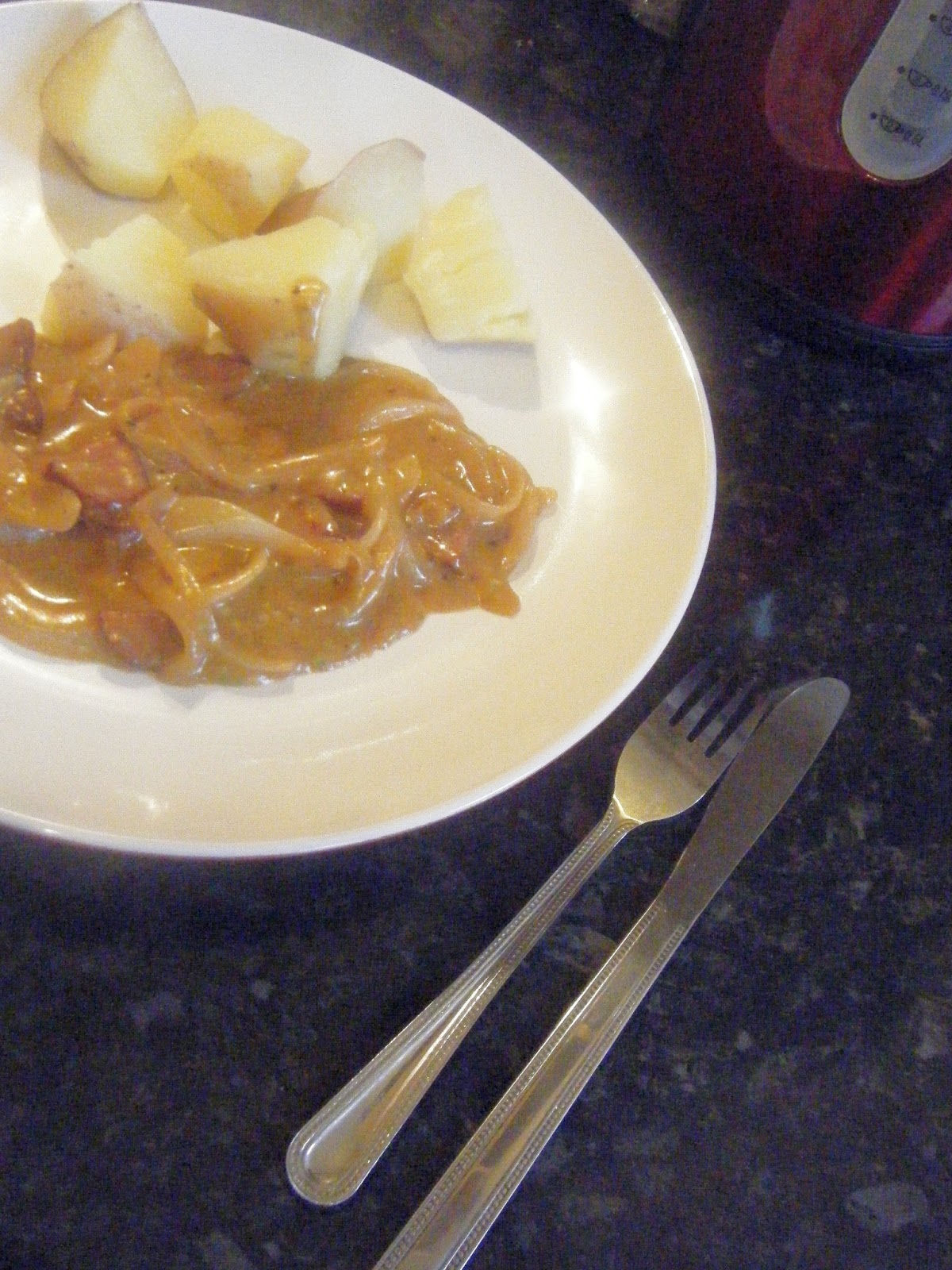
Polska Surowa Smoked Sausage in a Cheese Sauce
Thinly sliced Surowa smoked and peppered sausage, fried with onion, until the onion begins to brown. The cheese sauce was made with cornflour, water, milk, a quarter teaspoonful of mustard powder, vegetable stock, two squeezes of tomato puree, and 80g of Sage Derby cheese. Stir continuously until the sauce thickens. A pinch of oregano was added to the sauce before it was added to the onion and the sausage.
Serve with boiled potatoes, or penne, or fusili pasta.
Polska Surowa Smoked Sausage in a Cheese Sauce
Labels:
Cheese,
Cornflour,
Fusili,
Herbs,
Milk,
Mustard Powder,
Onion,
Oregano,
Pasta,
Penne,
Peppered Sausage,
Potato,
Sage Derby,
Sausage,
Smoked Sausage,
Surowa,
tomato puree,
Vegetable Stock,
Water
Tuesday, 22 November 2016
Omelette with Crumbed Ham
Some bargain crumbed ham from Tesco yesterday prompted me to make a ham omelette for breakfast, and American style, without browning. I beat two eggs together in a bowl, with a dash of water, and added the mixture to a pre-heated omelette pan. The pan was brushed with a little sunflower oil, and was at a medium heat. I turned the heat down to the second lowest setting once the mixture was in the pan. Cooked for three to four minutes on one side, flipped, and for another three to four minutes on the other side.
Decant the omelette onto a plate, and place a folded circle of crumbed ham on one half of the omelette, and fold the omelette over it with a spatula or fish slice. Serve with American or German mustard, and freshly ground black pepper.
Omelette with Crumbed Ham
Wednesday, 17 August 2016
Poached Eggs with Pease Pudding
This dish could have been prepared and enjoyed in the neolithic in northern Europe. They had peas, herbs, probably some form of fermented condiment, sea salt, butter, milk, cream, and perhaps some form of yoghurt. And they had eggs.
Preparation would have been different (which I will describe later), but the result would have been very similar.
I blended about thirty pods of peas, along with a couple of pinches of dried tarragon, decanted the blended mixture into a small pan. I added a small pinch of sea salt, and about half a teaspoonful of Asian Nam Pla fish sauce, which is the sort of condiment which they may have had, similar to Roman garum. Cooked at a low heat with a knob of butter and two teaspoonfuls of yoghurt (or fresh cream) stirred in, for ten minutes under glass, stirring occasionally. Peas when pulverised take up more water than they do when intact, as I discovered while cutting spelt flour and pea flour together to make bread. So do not be afraid to add a little water to the mix.
The poached eggs were lowered into a lidded pan of boiling water in silicon poachers, and cooked for four minutes with the hob turned way down, so that the yolks were still runny in the centre.
Tempting to eat with pepper, but they probably (and almost certainly) had no access to pepper in the Neolithic in northern Europe.
Poached Eggs with Pease Pudding
Cooking in the European neolithic was often a communal affair, with many different items being cooked in cloth bags or other metal or ceramic vessels lowered into a boiling cauldron. So, the peas may have gone into a cauldron whole, in a cloth bag, until they lost their integrity. They would then be further mashed before serving and other possible ingredients of a tasty pease pudding added (such as the butter, cream, and the condiments). Boiled eggs they would certainly have eaten, but hard to say about poaching them. The end result is very similar, though the shape of the poached egg is different because it has been shelled first.
Pease pudding was probably used in much the same way as we use potatoes or rice - as the staple to accompany the main part of the dish, such as fish, pork, beef, lamb, chicken, etc.
This is a delicious and subtly flavoured dish which takes very little time to make, and gives the lie to the idea that food in the neolithic was generally a bad experience.
Labels:
Butter,
Cream,
Egg,
Fish Sauce,
Garum,
Green Pea,
Herbs,
Milk,
Nam Pla,
Pea,
Pease Pudding,
Poached Egg,
Salt,
Sea Salt,
Tarragon,
Water,
Yoghurt
Thursday, 11 August 2016
Roast Shoulder of Lamb with Butternut Squash
The ingredients for this are: a stringbound one kilogram boneless shoulder of lamb, one medium sized butternut squash, one small white or red onion, lamb stock, a teaspoonful of coriander seed, a large pinch of rosemary.
I used a large roasting dish with a lid. The oven should be preheated to around 195 deg C. The lamb shoulder was placed in the dish without oil. The squash was cut up into squares and placed around the lamb joint. I added two centimetres of water to the dish at this point. The onion was cut into thin slices and also placed around the lamb. I used a lamb stock cube, cut into thin slices, also placed around the roasting dish. Likewise with the coriander seeds and the rosemary, though some of the rosemary was used to dust the surface of the joint.
The joint was cooked for 50 minutes per 500g under the lid, followed by thirty minutes without the lid. Gorgeous smells in the kitchen from 30 minutes in! Aluminium foil can be used instead of a covered roasting dish.
Allow thirty minutes for the joint to cool. Remove the string, and cut with an electric knife into slices.
This dish is best served the following day, after the butternut squares and gravy have been in the fridge overnight. The solidified fat then can be removed with a sarsaparilla spoon. The butternut and the gravy can be reheated in a saucepan, and the lamb slices in a steamer.
Serve with the butternut squash and the onion, with spoonfuls of the juices. Will serve five or six people. Cooking the lamb under glass for most of the process results in wonderfully tender and juicy lamb. Utterly delicious!
I used a large roasting dish with a lid. The oven should be preheated to around 195 deg C. The lamb shoulder was placed in the dish without oil. The squash was cut up into squares and placed around the lamb joint. I added two centimetres of water to the dish at this point. The onion was cut into thin slices and also placed around the lamb. I used a lamb stock cube, cut into thin slices, also placed around the roasting dish. Likewise with the coriander seeds and the rosemary, though some of the rosemary was used to dust the surface of the joint.
Roast Shoulder of Lamb with Butternut Squash
The joint was cooked for 50 minutes per 500g under the lid, followed by thirty minutes without the lid. Gorgeous smells in the kitchen from 30 minutes in! Aluminium foil can be used instead of a covered roasting dish.
Allow thirty minutes for the joint to cool. Remove the string, and cut with an electric knife into slices.
This dish is best served the following day, after the butternut squares and gravy have been in the fridge overnight. The solidified fat then can be removed with a sarsaparilla spoon. The butternut and the gravy can be reheated in a saucepan, and the lamb slices in a steamer.
Serve with the butternut squash and the onion, with spoonfuls of the juices. Will serve five or six people. Cooking the lamb under glass for most of the process results in wonderfully tender and juicy lamb. Utterly delicious!
Wednesday, 3 August 2016
Ground Lamb with Garlic & Leek
This recipe really brings out the flavour of the lamb. Ingredients are: 300g of ground (minced) lamb, six cloves of garlic in sunflower oil suffused with red chilli (bought from Aldi), one medium sized leek, eight Gem baby potatoes, green beans, lamb stock, and some oregano and salt.
The lamb should be cooked n a saute or other suitable pan, at a high heat with no added oil, until it begins to brown. Add chopped leek and stir together well. Cover the pan with a glass lid, and allow to cook for twenty minutes to half an hour at a low heat, stirring occasionally. Blend the six garlic cloves together in a vegetable chopper, and add to the pan. Add boiling water, and some lamb stock. Allow to simmer for another 45 minutes or so.
Add the washed potatoes to a lidded pan with an inch of water, add salt, and bring to the boil. Dust some oregano on top of the potatoes. Cook for twenty to twenty-five minutes. Add the green beans to the pot six minutes before the end of the cooking time, and allow to steam on top of the potatoes. Remove the potatoes and the green beans from the pot with a slatted spoon or with cooking tongs. Serve piping hot.
Labels:
Bean,
Garlic,
Gem Potato,
Green Bean,
Ground Lamb,
Lamb,
Lamb Stock,
Leek,
Oregano,
Potato,
Red Chilli,
Salt,
Sunflower Oil,
Water
Monday, 1 August 2016
Bacon Goujons, with Brocolli
Lots of cheap vegetables available at the moment, so I blended about 20 cherry tomatoes, rather than opening a tin. I cooked the bacon goujons first, in a saute pan, then added half a yellow pepper, cut into thin strips. Once the bacon goujons had begun to brown, I added some boiling water, and then the blended cherry tomatoes.
Cooked at a low heat until the salsa had boiled down to a thick sauce. About thirty minutes altogether. I added two teaspoonfuls of green pesto sauce (Sacla brand), some black pepper, and a dash of Tabasco.
The brocolli was cooked in a lidded pan (water and steam) for ten minutes at a high heat, and, after draining, cut into segments on the plate. A delicious combination of flavours!
Bacon Goujons, with Brocolli
Tomato and Celery Broth
Some bargain vegetables were bought in the local co-op on a Sunday afternoon, including salad tomatoes, carrots and leek. With celery from the fridge, I had the ingredients to make a tasty tomato and celery broth.
Chop up one mid-sized leek, four sticks of celery, shred half a dozen salad tomatoes, and 750 grams of carrots. Add to 2 litres of boiling water, and cook for half an hour. Add two ham stock cubes, and one vegetable stock cubes. Plus a teaspoonful of black pepper. I also added a handful of Khorasan wheat (Kamut), for flavour and thickening (adding that means this is not a wheat-free recipe).
After the first period of cooking, mash the contents of the pot. Cook for another 45 minutes under glass at a low simmer. Add some shredded basil leaves, and cook for a further 10 to 15 minutes before serving.
Tomato and Celery Broth
Labels:
Basil,
Black Pepper,
Broth,
Carrot,
Celery,
Ham Stock,
Herbs,
Kamut,
Khorasan Wheat,
Leek,
Soup,
Tomato,
Vegetable Stock,
Water,
Wheat
Saturday, 30 July 2016
Omelette with Double Gloucester Cheese and Chives
A simple two egg omelette topped with roasted Double Gloucester cheese with chives, and served with buttered toasted wheat free bread.
Beat two eggs thoroughly after adding half a teaspoonful of water to the mixing bowl. Allow to stand. Slice 75 grams of the cheese into squares, or grate it if you prefer (I chose to grate the cheese in this case). Put a little sunflower oil into an omelette pan, and brush evenly over the surface. Once the pan is hot, beat the eggs again, and pour into the pan. Turn down the heat so the omelette does not burn, and cook for two minutes. Cover the surface of the omelette with the cheese.
Remove the pan from the hob and place under a preheated grill. All grills are different, so this part of the process needs to be watched by eye. The pan should be just a couple of inches under the grill element, with the handle facing outwards. Turn the pan left after a couple of minutes, and then right after a couple more, keeping the handle away from the element as far as possible. Grill until the surface of the omelette is golden brown.
Serve with buttered wheat free brown bread, black pepper, and brown pickle (Branston pickle in the picture) or ketchup.
Omelette with Double Gloucester Cheese and Chives
Sunday, 17 July 2016
Beef Olive
A popular favourite in Scotland, beef olive is rather mysteriously named, since it contains no olives. The essence of the dish is thinly cut beef which is wrapped around a filling, usually of some kind of sausage meat enriched with herbs. So it has been suggested that the association is with olives, which are often stuffed with pimiento once the olive stone is removed. So in a sense a beef olive is beef stuffed with sausage.
The filling can be either beef or pork sausage meat, mixed with soya flour, rice flour, oat flakes, or something else which isn't wheat. The proportions should be about 50 per cent meat, 30 per cent flour, and about 20 per cent finely chopped red onion, enriched with lots of herbs. If the stuffing is pork, one of the best choices of herb to use is sage. The choice is yours. Add a little salt.
Place the thin cut beef on a chopping board, dust the inside with a little flour and a small amount sunflower oil, add the stuffing, rolled, and wrap it in the beef. Press the olive a little (with the overlap of beef on the bottom) to ensure that it will stay in its wrapping in the casserole dish (a bed of vegetables helps secure this).
Beef Olives
Raw Beef Olives on a bed of Curly Kale and Red Onion
Labels:
Beef,
Beef Olive,
Black Pepper,
Curly Kale,
Herbs,
Kale,
Oat Flakes,
Pork,
Red Onion,
Rice Flour,
Sage,
Salt,
Sausage,
Soya Flour,
Sunflower Oil,
Water
Saturday, 16 July 2016
Venison Sausage in a Red Currant Sauce
Low fat venison and pork sausages in a red currant sauce, served with boiled swede and potato, and a parsley garnish.
The sauce was made with cornflour and water, with some pork stock, which was boiled until it thickened. The red currant component came from a jar of red currant jelly - two teaspoonfuls of it. The dish has a delicious combination of flavours.
![]() |
Venison Sausage in a Red Currant Sauce |
Labels:
Cornflour,
Low Fat,
Parsely,
Pork,
Pork stock,
Potato,
Red Currant,
Sauce,
Sausage,
Swede,
Venison,
Water
Subscribe to:
Posts (Atom)